

Greenhouse Humidity Control
Trapped humidity, especially at daybreak, is the single biggest driver of mold, bud rot, and disease pressure in greenhouses. AutoVent controllers dump that moisture automatically, before it becomes a problem.
How trapped moisture destroys a crop
Greenhouses are designed to hold heat, which means they also hold water vapor. Without active humidity management, that vapor condenses, stagnates, and feeds the organisms that kill plants.
Bud Rot & Gray Mold
Botrytis cinerea thrives above 85% RH. Once established in a flower or bud, it spreads rapidly through the canopy often destroying entire sections overnight. No spray program fixes a consistently humid environment.
Wet Leaves & Surface Mold
When humidity exceeds the dew point, water condenses directly on leaf surfaces. This creates ideal conditions for powdery mildew, bacterial leaf spots, and other surface pathogens even with no irrigation events.
The Daybreak Spike
Plants respire overnight, exhaling moisture into a cold, closed greenhouse. By dawn, humidity reaches its daily peak, often 90%+, just as temperatures are rising. This is the most dangerous window of every day.
How AutoVent's Humidity Control Works
Sensor reads relative humidity
The RPH-310 humidity sensor mounts inside the greenhouse at canopy height, where it matters, and continuously feeds RH readings to the controller.
Controller compares to your setpoint
You dial in your maximum acceptable RH. When the sensor reading exceeds it, the controller acts. No manual checking required.
Vents open or fans turn on
Depending on your setup, the controller triggers ridge vents, side wall vents, or exhaust fans, whatever moves air out of your structure and moisture with it.
Setpoint adjusts with temperature
Humidity-compensated control means the target RH shifts proportionally as air temperature changes, so you’re not constantly re-dialing after weather swings.
The daybreak humidity dump and why it matters
Dif is the difference between daytime and nighttime temperatures, a technique used to control plant stretch. But there’s a humidity side to Dif that most growers miss.
“Every morning at sunrise, you have a window, maybe 30 to 60 minutes, where the humidity spike from overnight respiration is at its peak. If you can dump that moisture before the day heats up, you change your disease pressure for the entire day.”
— Kevin, AutoVent
A properly configured controller can be set to open vents aggressively at a timed pre-dawn window, regardless of temperature, targeting that RH spike directly. AutoVent controllers support both RH-triggered and time-triggered vent positions, so you can program the dump and walk away.
Controllers that Handle Humidity
Every controller below supports RH-based control, either as a standard feature or an add-on option. All are compatible with the RPH-310 humidity sensor.

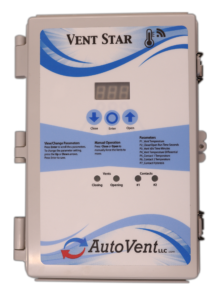
VentStar
AutoVent's rack-and-pinion vent controller for gutter-connected and freestanding greenhouses. Humidity control is an add-on option, ideal for growers who want to start with temperature and layer in RH management later.
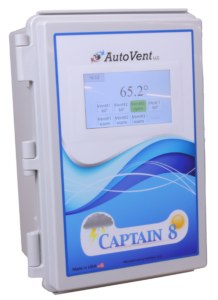
Captain 8
Eight-stage temperature control with humidity compensation built in. As RH climbs toward your setpoint, the Captain 8 adjusts vent position or fan speed before moisture becomes a problem.
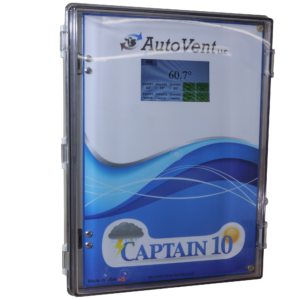
Captain 10
The expanded 10-stage version of the Captain series, adding two additional control stages for larger or more complex operations. Same humidity compensation as the Captain 8, with more headroom for layered control strategies.
RPH-310 Humidity Sensor
The RPH-310 is AutoVent’s dedicated relative humidity sensor, designed to work directly with the VentStar (with humidity option), Captain 8, and Captain 10 controllers. It’s the missing link between your greenhouse air and an automated response.
Measure
Relative humidity (%RH) and temperature
Mount location
Inside the greenhouse, at canopy height away from direct sun and water
Output
Compatible with all current AutoVent humidity-capable controllers
What to expect
Initial setup takes 15–20 minutes; readings are immediate and continuous
Talk to AutoVent about your humidity setup
Let us know your structure type, crop, and what you’re seeing, and we’ll help you choose the right controller and sensor configuration. No upselling, just an honest recommendation.